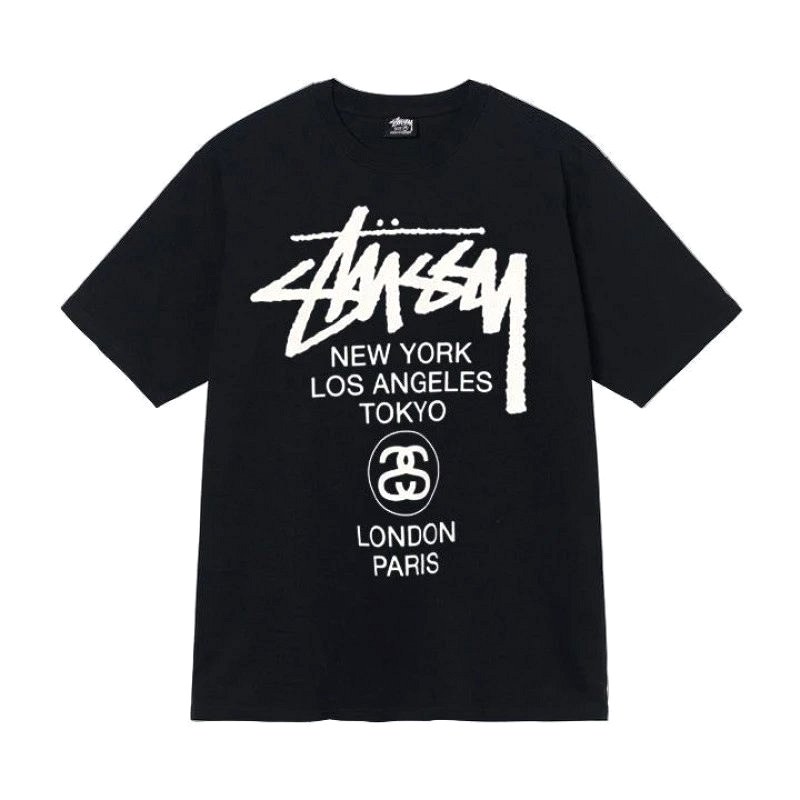
We ordered the Stussy letter-print black T-shirt (SKU 7718808120) through Superbuy and put it through our usual desk routine in Hong Kong: parcel inspection, tape measure against the listed S–XXL chart, a close look at the neck rib, shoulder tape and hem stitching, then a hand wash and hang dry. The listing price is $8.06, down from $9.46, and availability is marked in stock.
What the catalog actually specifies
The spec sheet is far more detailed than the price suggests. It lists pure long-staple cotton at 250–300 gsm, an anti-iron (non-iron) finish, and fabric functions of breathability, wrinkle resistance and moisture wicking. The cut is described as loose with a classic crew neckline and short sleeves, aimed at a basic, mass-market streetwear register that the catalog says suits teenagers. Colors run from the 848 series through 918 — 873, 874, 875, 876, 850, 851, 852, 877–884, 885–888, 911, 912, 913 and 918 — which adds up to 80 listed colorway labels across black, white, royal blue, red, pink, green, beige, purple, yellow, brown and grey. Sizes are S, M, L, XL and XXL.
Two catalog fields deserve a caveat. The stated measurement tolerance is 1–2 cm, which is normal in this price band but matters if you want a precise fit rather than an approximate one. And the listed weight reads 0.00, so it tells you nothing to budget shipping against — ask your agent for the packed weight before you consolidate a haul.
Materials and construction on the bench
Hand-feel matched the midweight claim rather than a heavyweight one. The jersey has the dry, faintly papery surface we associate with long-staple cotton in the 250–300 gsm range, not the plush, dense hand of a 400 gsm boxy blank. The non-iron finish shows up the way it should: the shirt came out of the bag flat and smooth with no pressing needed, which is useful when a tee is going straight from a warehouse into a parcel.
Under daylight we checked the neck rib for recovery, the shoulder-to-shoulder taping, the side seams and the sleeve and hem stitching. Nothing on our sample read as fragile, and the neckline sprang back after being stretched over a hanger. The print area itself is a flat white graphic combining the brand name, city names and a circular emblem, and on our sample the edge definition held up when we looked at it at an angle.
Fit against the size chart
We measured the chest and body length of our size L against the listed chart and both sat inside the stated 1–2 cm window. The cut is genuinely loose through the body with a lower, relaxed armhole, so it hangs away from the torso instead of clinging. Buyer guidance on Stussy tees generally agrees that going true to size already produces a relaxed look, with a size up reserved for people who want it baggier still. If you usually wear a fitted or slim tee, this is a different silhouette than you are used to.
The print: the one thing we could not confirm
Nothing in the listing names a print method, and that is the single largest unknown on this piece. It matters because print durability is not equal across methods. Screen printing pushes ink through a mesh stencil into the fabric, leaving edges with a natural micro-serrated character and a thin, integrated ink layer. Heat transfer sits on top of the fabric as a heavier film with very smooth, sharp edges and a plastic sheen that catches light. Retail-authentication guides use exactly that difference — ink layer thickness and edge character — as a first-line test, and the same logic applies here.
Ask your agent for a raking-light close-up of the chest graphic before the parcel leaves the warehouse. Screen-print edges look slightly jagged under angled light; a transfer film looks smooth, glossy and raised. If the photo is ambiguous, treat the print as an unknown rather than assuming the better method.
Forum reports on Stussy reps are mixed on this point. Buyers of pure-cotton Stussy blanks describe them as soft, fairly thick and close to the original, but the same community also complains that genuinely high-quality Stussy tees are thin on the ground and that chest prints can wear over time. Those are category-level claims about Stussy reps in general, not findings about this listing, and we are keeping them at that level.
What we compared it with
| Comparable tee | How this Stussy crew differs |
|---|---|
| Budget 180–200 gsm graphic tee | Noticeably more body and better drape; the Stussy sits away from the skin rather than collapsing onto it once damp. |
| Heavyweight 280 gsm-plus boxy blank | Lighter and less structured, with a softer collar roll. Easier to wear indoors, less of a statement shape. |
| Slim-fit cotton crew | A completely different silhouette. This tee is loose through the chest and waist, so sizing down gets you nearer to a regular fit, not a slim one. |
| Vintage-wash printed tee | Crisper, brighter white graphic and a smoother face; the non-iron finish makes it look newer for longer, which is not always what vintage-wash buyers want. |
Wash, shrinkage and care
The fabric is listed as pure cotton, and pure cotton can shrink if you wash it hot and tumble it dry. Buyers of 100% cotton Stussy tees commonly hand wash or hang dry for that reason, or accept a little shrinkage and buy true to size. Wash cold and inside out, skip the dryer, and keep an iron off the graphic itself. Combined with a 1–2 cm manufacturing tolerance, that means a tee bought at the top of your size range can end up snugger than expected — the loose cut gives you some margin, but not unlimited margin.
Ordering notes for an 80-colorway run
The color run is the most practical feature here. Because the same graphic appears under dozens of labels, reordering a shade you liked is simple, and a black version that fades or gets stained is cheap to replace at $8.06. The flip side is that similar names can hide different print layouts — 850 has both a black-on-black treatment and a black-and-white one, for example — so send your agent the exact label, not just "the black one". Request in-hand photos of the specific colorway before dispatch, since the seller's gallery shots cover only a fraction of the run. A second buy at this price is also the cheapest way to test print durability for yourself: one to wear, one to keep boxed as a comparison.