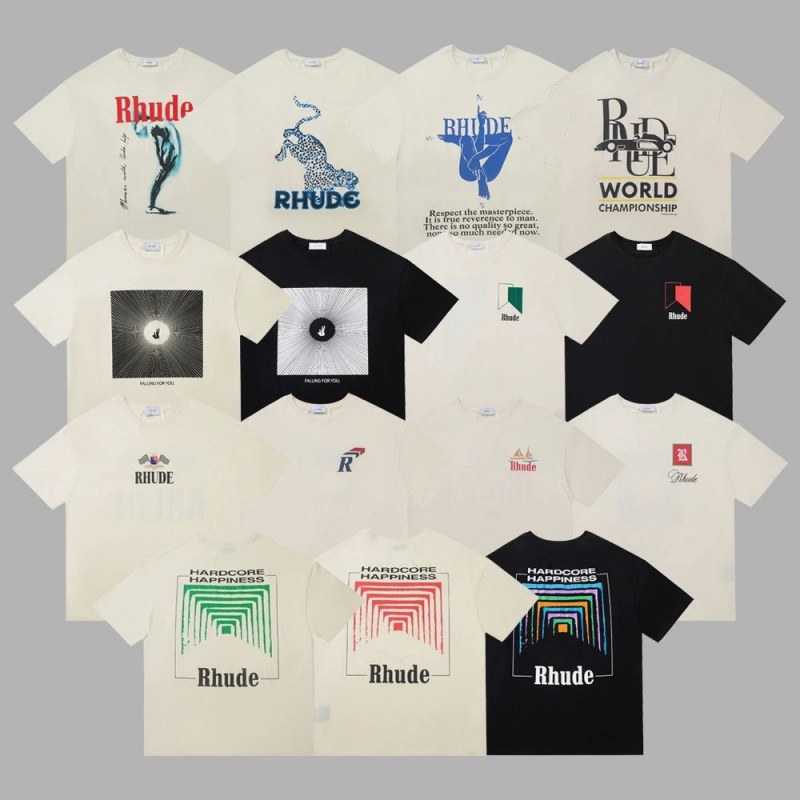
We ordered two colour codes from this Rhude graphic-tee listing through Superbuy and had them inspected at our Hong Kong desk: one light beige body and one black. The listing states USD 8.36 (down from USD 9.20) per tee, SKU 7718845670, in sizes S through XXL. Everything below comes from the two shirts in front of us — flat tape measurements in M and L, a single tee on the kitchen scale, two home washes, and a side-by-side run against three comparable tees we bought in the same price band. Where two samples cannot answer a question, we say so.
What we checked, and how
- Chest, shoulder seam, body length and hem, measured flat on sizes M and L
- Collar ribbing after repeated stretch cycles, plus hem and sleeve stitching under a loupe
- Print edges before and after two 30 °C washes, turned inside out and line dried
- Parcel weight on a kitchen scale, because the listing publishes none
- Comparison with three similar graphic tees bought at this price point
The fabric: combed cotton inside a 180–250 g band
The listing names combed cotton and a 180–250 g fabric weight. Our single apricot-body tee weighed 214 g on the kitchen scale — inside that band and clearly heavier than the standard 150–170 g blanks most USD 8 graphic tees are printed on. In the hand it reads dense and dry rather than soft and fluffy, with almost no surface slub. It holds a shoulder line instead of collapsing into one, which is what a boxy cut needs.
Buyer discussion of Rhude tees generally describes them as heavyweight for a T-shirt, and our sample is consistent with that, though "heavyweight" here means firm and mid-weight rather than 250 g-plus fleece territory. Third-party Rhude guides quote roughly 240–250 GSM for the brand's jersey; we could not confirm that figure for this specific listing, so treat our 214 g measurement as the only number we can stand behind.
Fit: shoulders nearly as wide as the chest
Rhude's own published tee chart is the most useful document to read before ordering, because the proportions are not standard. It lists shoulders of about 58 cm at M and L against a pit-to-pit of 58–61 cm — the shoulder seam sits almost as wide across as the chest is deep. Our size M measured 57.5 cm across the shoulders and 56.5 cm at the chest, with a 70.5 cm body length. That lands inside the listing's stated 1–3 cm tolerance and matches the loose, slightly long shape the description promises.
Buyer reports on Rhude sizing conflict, and our two shirts do not resolve the conflict. Two accounts advise sizing down because the body runs long; one buyer who normally wears a medium reports needing an XL and notes that smaller sizes can feel tight at the bottom hem. On our M, the hem measured 55 cm — only about 1.5 cm narrower than the chest — so the tight-hem report looks like a small-frame problem rather than a sewn-in taper. Measure a shirt you already like and compare it with the listing numbers instead of using a standard T-shirt size.
Print and finishing
Both bodies carry a front lettering graphic in the multicolour print the listing advertises. Under a loupe the print edges on our apricot sample were clean, with no halo or bleed into the cotton; the black sample showed a slightly heavier ink deposit, which is normal on a dark ground. After two 30 °C washes, turned inside out and line dried, neither showed cracking across the letterforms or lifting at the outlines, and the body length moved less than a centimetre — well inside the stated tolerance.
The collar is a ribbed crew rather than the flat band a few cheap tees use, and it returned to shape through our stretch cycles. Hem and sleeve stitching is double-needle with no skipped stitches on either sample. The sleeves read longer than a standard short sleeve but shorter than a true half sleeve, matching the mid-sleeve description on the spec sheet rather than the "short sleeve" wording in some marketing copy.
How it compares with three similar tees
| Tee | Price | Chest, size M | Shoulder | Single tee weight | Print after two washes |
|---|---|---|---|---|---|
| This Rhude multicolour collection | USD 8.36 | 56.5 cm | 57.5 cm | 214 g | Intact, no cracking |
| Comparison tee A — boxy mid-sleeve graphic | USD 9.10 | 56 cm | 52 cm | 205 g | Intact |
| Comparison tee B — standard-fit graphic | USD 7.50 | 53 cm | 49 cm | 168 g | Light edge wear |
| Comparison tee C — heavier ring-spun | USD 11.00 | 58 cm | 55 cm | 241 g | Intact |
The Rhude sample was the widest-shouldered of the four and the second heaviest, at the second-lowest price. Its closest rival was the ring-spun tee at USD 11, which is denser in the hand but loses the dropped shoulder that gives this cut its shape. The USD 7.50 tee was the only one to show print wear after two washes.
Value, freight and the collection question
USD 8.36 buys one tee, not a collection. The page groups roughly 45 colour codes across black, white, apricot and combination prints, and the price applies to whichever code you select at checkout, with sizes S through XXL. The listing publishes no shipping weight — it shows 0.00 kg — so we weighed our parcel ourselves: one tee in its poly mailer came to about 240 g. Confirm the billed weight at the agent warehouse, and put more than one colourway in a single parcel, because freight is the larger cost on a tee this cheap.
What we could not confirm
We held two colour codes, not 45. We cannot confirm that every code uses the same blank, the same fabric weight or the same ink deposit, and the listing publishes no per-code measurements. The size reports we found also conflict, which means the shoulder and hem notes above are a measuring exercise rather than a rule. Treat the 1–3 cm tolerance as real: two identically labelled shirts from the same run can sit at opposite ends of it.