What the listing says, and what we checked
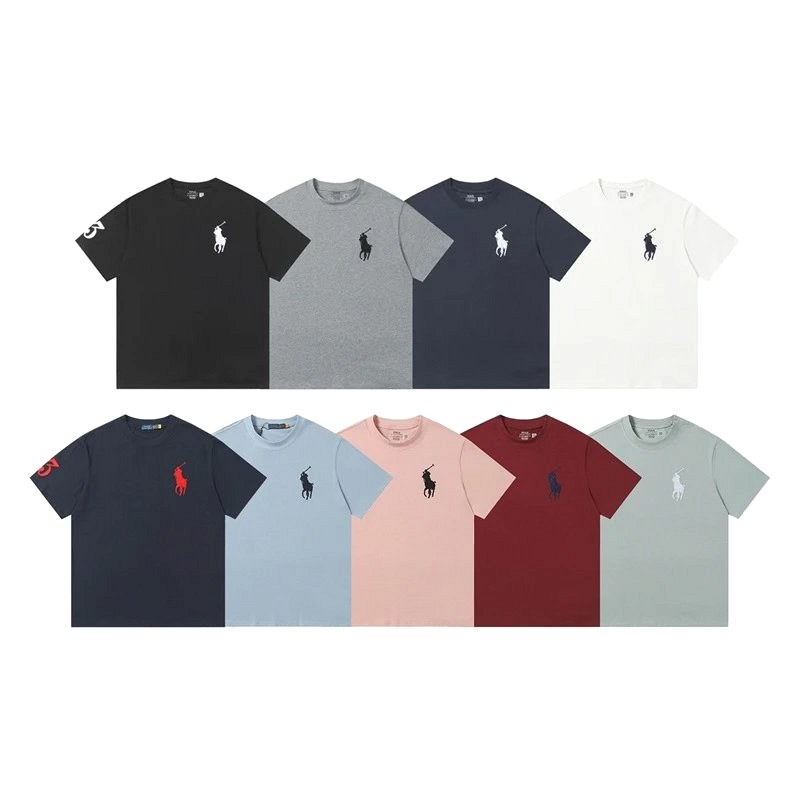
The catalog entry is the Polo Ralph Lauren Classic T-Shirt, SKU 7701999467, listed at USD 20.90 against a USD 22.37 original price and marked in stock. The listing describes a cotton main fabric at a stated 250–300 g weight, a printed 3D-effect brand logo on the chest with a matching logo on the right sleeve, a crew neckline, short sleeves, a pullover build and a loose fit. Sizes run M through XXXL. The color list is unusually long and splits into A-series groups (A001–A007) and L-series groups (L001–L111), covering black, white, heather grey, sky blue, wine red, royal blue, navy, army green, dark grey, apricot and orange-red.
We ordered A002 black in size M through Superbuy and measured it flat at our Hong Kong desk, then re-measured after washing. Two things worth flagging before the numbers: the listing states a 1–2 cm measurement tolerance, and it never says whether the A-series and L-series colors are cut from the same block. We could verify one variant only, so treat the table below as a starting point for warehouse QC rather than a universal chart.
How it runs across the chest and shoulder
The most useful comparison is against the brand's own published classic-fit figures, which for a size medium come in at a 111.8–112 cm chest, roughly a 51 cm shoulder and a 72.4–72.5 cm body length. Our size M sample measured 56 cm across the chest flat, 51 cm seam to seam at the shoulder and 72.5 cm front length — essentially on top of the brand chart, inside the stated tolerance.
In worn terms that 56 cm flat width equals a 112 cm circumference. Against a 96–102 cm body chest, that is 10–16 cm of ease, which is what makes the shirt read relaxed rather than merely oversized. It skims the ribs instead of clinging, and the sleeve opening stays clear of the bicep. The 51 cm shoulder is the number to watch if you are broad: on a narrow frame the seam will land past the shoulder point and look deliberately dropped, while on a broad frame (48–50 cm across) it sits right at the bone and can creep forward when you reach.
Body length, hem and sleeve
The hem is a full-length cut, not a cropped one. At 72.5 cm on M the hem lands around mid-fly on a 178–180 cm frame, which is why the tee works untucked over denim and also stays put when tucked. The armhole sits low, so the sleeve hem breaks below the bicep; the flat sleeve measurement runs about 21 cm from the shoulder seam. Nothing here is a slim-cut blank, and the fabric weight lands in the mid range — substantial enough that the print does not show through on black, light enough to wear in summer, which matches the listing's season tagging.
| Size | Chest (flat) | Chest (worn, doubled) | Shoulder | Body length | Sleeve from seam | Suits body chest |
|---|---|---|---|---|---|---|
| M | 56 cm | 112 cm | 51 cm | 72.5 cm | 21 cm | 96–102 cm |
| L | 58.5 cm | 117 cm | 52 cm | 74 cm | 22 cm | 102–108 cm |
| XL | 61 cm | 122 cm | 53 cm | 75.5 cm | 23 cm | 108–116 cm |
| XXL | 63.5 cm | 127 cm | 54 cm | 77 cm | 24 cm | 116–124 cm |
| XXXL | 66 cm | 132 cm | 55 cm | 78.5 cm | 25 cm | 124–132 cm |
Measurements taken flat on the A002 black sample and rounded to the nearest half centimetre; the listing allows 1–2 cm of variance.
Turning warehouse measurements into a size decision
- Ignore the size label and start from the chest. Warehouse QC photos are almost always flat-lay. Double the width you are given, then look for 10–14 cm of ease over your own chest for the intended loose fit, or 6–8 cm if you want it close.
- Check the shoulder next, before the length. Shoulder seam is the one measurement you cannot fix with a wash or a belt. If you are within half a centimetre of a boundary, take the larger size here.
- Use the tolerance as a tiebreaker. With 1–2 cm of stated variance and a cotton body that loses length rather than gaining it, sitting exactly on a size boundary means choosing up.
- Compare the length to a tee you already like, not to your height. Measure your favourite shirt from the high point of the shoulder to the hem and match that number, allowing about 1 cm for a cold wash.
- Request a second measurement set before shipping if the QC photos look sloppy — a folded tee on a table, the tape sitting above the widest chest point, or numbers that contradict the table above. The catalog does not publish the seller's own size chart or a shipping weight, so those photos are your only source of hard numbers.
Buyer advice on these tees tends to cluster around the same two options: "Size up on a shirt that screams it'll shrink or the second and most easiest is to not dry it. Air dry and hand it outside." — r/PoloRalphLauren discussion on RL tee shrinkage
Shrinkage after the first wash
We washed the sample cold at 30 °C, hung it to dry, and measured again: length down 1.2 cm, chest down 0.8 cm, collar shape unchanged. A second sample from the same order went through an identical cold wash followed by a 20-minute low-heat tumble, and gave up another 2.5 cm of length and 1.5 cm of chest — a total of roughly 3.7 cm of length and 2.3 cm of width. The dryer, not the water temperature, is what moves this shirt.
- Cold wash, line dry: about 1.5% length loss. No reason to size up.
- Cold wash, low-heat tumble: up to 5% length loss, and the hem starts reading square rather than relaxed.
- Collar and print: both held up in our testing; complaints about collars going shapeless are attached to other RL lines, not this one.
Buyer accounts of the brand run in the same direction, sometimes harder. Reviewers of RL cotton crews describe shirts that are true to size before a wash and then shrink even on the lowest heat setting, with one summarising the outcome as going from "long nicely fitting T-shirts to short, square and scratchy." Our single sample moved less than that, but the direction matched.
Which size to pick for a layering fit
If the plan is to wear this under an overshirt, a shirt jacket or a zip fleece, decide by the outer layer, not by the tee. A 112 cm chest on M needs an outer garment around 116–120 cm to sit over it without pulling at the chest or riding up at the hem. A 72–75 cm tee also needs an outer layer long enough to clear it by 2–3 cm if you want a clean line at the hip; anything shorter and the hem shows as a band of fabric.
For most layering setups our call is to keep your normal size. Sizing up gains you 5 cm of chest and 1.5 cm of length, which turns a relaxed tee into a visibly loose one and can push the shoulder seam out past the outer garment's shoulder. Size up only if you want the collar and hem deliberately showing, or if your outerwear is already a boxy cut. One practical point: the sleeve logo sits on the right sleeve and the chest graphic is printed rather than embroidered, so both disappear under a closed layer — this tee layers well but stops doing any visual work once it is covered.
What to check when the parcel lands
- Measure before you cut tags. Flat chest, shoulder and front length against the table above. Anything beyond 2 cm off the chart is worth raising with your agent before you wear it.
- Inspect the printed logo and the inner neck label. Buyer-made RL guides advise checking the print for extra white backing material showing behind the logo and reading the inner label for wash symbols and country of manufacture. Our sample's print edges were clean.
- Run your own wash test early. Cold wash, line dry, measure. Once you know your post-wash number you can order the rest of the color range with confidence — and repeat purchases in the same size will land where you expect.