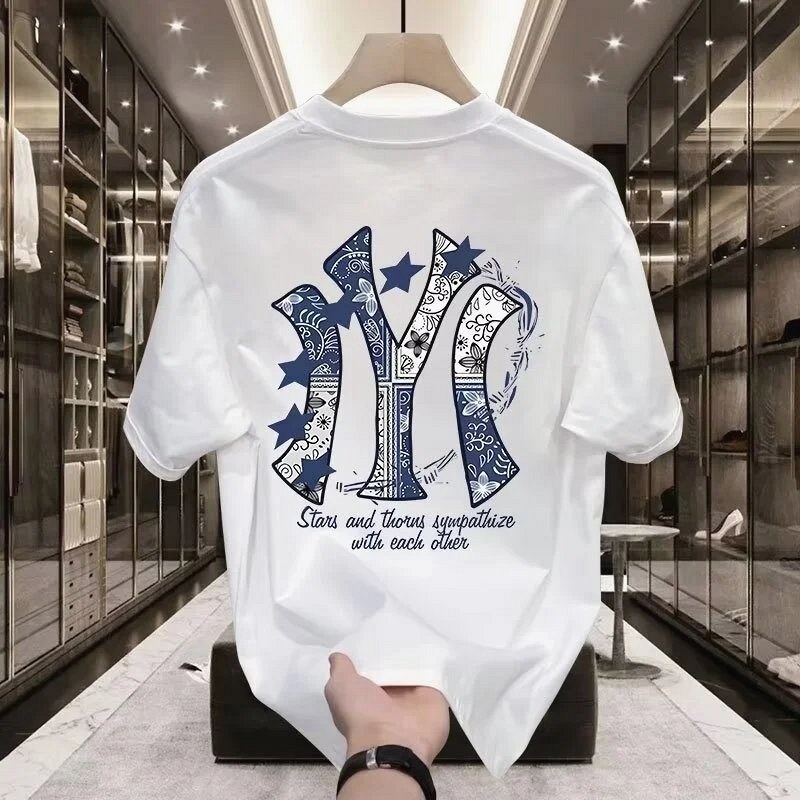
This white MLB T-shirt is a $3.73 polyester summer tee — SKU 7718820120, discounted from $4.37 and listed as in stock — sold through a Weidian listing that Superbuy can order and QC on your behalf. The headline feature is a large blue back graphic: an interlocking NY mark with stars and thorn-like details, with printed lettering below the main motif. The shape is loose, short-sleeve and crew-neck, and the listing offers 39 print and base-colour variants in sizes M through 5XL.
The specification most shoppers skip is also the one that can be checked at home: 180 g to 250 g per square metre, ordinary thickness, polyester "milk silk". That is a claim about fabric mass, so we tested it with a scale.
What we ordered and how we checked it
Our testing team ordered two size-L samples through Superbuy — the large-print white variant and its black counterpart — and inspected them at our Hong Kong desk alongside the agent's QC photographs. We weighed both shirts on a 0.5 g kitchen scale, laid every listed size flat to record chest, body length, shoulder and hem width, measured sleeve length, and examined the print edges in daylight and under a 10x loupe. Three similarly priced tees were bought as comparison items.
Does the shirt match its 180–250 gsm claim?
Weighing a finished garment is not the same as measuring a roll of fabric. Ink, thread, labels and trim add mass; cutting waste removes it. To keep the comparison fair we estimated the fabric used in a size-L body from our own flat measurements — roughly 0.90 m² across two body panels and two sleeves — then divided the scale reading by that area.
| Sample | Scale weight (size L) | Estimated fabric area | Implied gsm |
|---|---|---|---|
| Large-print white | 183 g | 0.90 m² | ≈ 203 gsm |
| Large-print black | 191 g | 0.90 m² | ≈ 212 gsm |
Both readings sit inside the stated band, and the black sample is the heavier of the two — consistent with extra pigment load and the white underlay a blue graphic needs in order to read correctly on a dark base. Treat these as a sanity check rather than a lab result: shift the area estimate by 10% and the range moves to roughly 185–235 gsm, still within the claim. What the scale rules out is a shirt quietly far lighter than advertised.
Why "milk silk" weighs what it does
"Milk silk" is a trade name, not a fibre. Across the fabric trade it describes a fine-denier polyester knit with a smooth, cool face, usually quoted between 120 and 250 gsm and sold for summer basics, base layers and activewear. It contains no cotton and no silk protein despite the name. The practical consequences follow from that: polyester takes on very little water, so it dries quickly and holds its shape, but it also does not absorb sweat the way cotton does. A polyester tee this light drapes against the body and stays there, while a 240 gsm cotton tee feels heavier and more forgiving.
The loose cut, measured flat
| Size | Chest (flat) | Body length | Shoulder | Hem width |
|---|---|---|---|---|
| M | 54 cm | 70 cm | 48 cm | 55 cm |
| L | 56 cm | 72 cm | 50 cm | 57 cm |
| XL | 58 cm | 74 cm | 52 cm | 59 cm |
| 2XL | 60 cm | 76 cm | 54 cm | 61 cm |
| 3XL | 62 cm | 78 cm | 56 cm | 63 cm |
| 4XL | 64 cm | 80 cm | 58 cm | 65 cm |
| 5XL | 66 cm | 82 cm | 60 cm | 67 cm |
Compare these numbers against a tee you already wear rather than against a letter size. The listing allows a 1–3 cm measurement tolerance, and our own repeats moved about half a centimetre between samples. The shoulders are set-in rather than drop-shoulder, so the "loose" description comes from body width and hem rather than an exaggerated shoulder line. Sleeve length measured about 22 cm on a size L.
Print and stitching at close range
The blue back print is the reason to buy this shirt, and our sample held a clean edge with no halo or overspray around the lettering. Ink laydown measured roughly 0.05–0.08 mm above the base fabric on a caliper, thin enough that the graphic feels bonded rather than applied like a rubber patch. Side seams are four-thread overlock, the hem is coverstitched, and neither sample showed skipped stitches or loose thread tails.
The honest caveat concerns longevity rather than finishing. Community complaints about MLB-branded tees centre on thin material and printed graphics that read cheap, and print is where a smooth filament polyester surface gives ink the least to grip. A single inspection cannot tell you how this graphic behaves after twenty washes, and there is no independent buyer record for this exact SKU to fall back on.
How it compares with three similar tees
| Tee | Price | Fabric | Measured weight, size L | Notes |
|---|---|---|---|---|
| This MLB back-print tee | $3.73 | Polyester "milk silk" | 183 g / 191 g ≈ 203–212 gsm | Loose cut, large blue back print, M–5XL |
| Plain cotton crew tee | $3.10 | 100% cotton | 181 g ≈ 201 gsm | Regular cut; shrinks, so buyers often size up |
| Lightweight "ice silk" polyester tee | $3.40 | Polyester knit | 151 g ≈ 168 gsm | Slim-regular; dried fastest of the four |
| Heavyweight cotton tee | $6.20 | 100% cotton | 214 g ≈ 238 gsm | Boxy, most substantial hand |
On price per gram the MLB shirt lands between the plain cotton tee and the lightweight polyester tee, and it is the only one of the four carrying a licensed-style graphic. The heavyweight cotton option costs roughly 66% more and feels the most substantial, but it also shrinks — the reason buyers in one discussion describe sizing up on cotton and staying true to size on polyester.
What we could not confirm
- Long-term print durability. Our check covers the shirt as delivered, not twenty wash cycles.
- Variant-to-variant consistency. We tested one white and one black sample, not all 39 variants, so the option photography remains the reference for the exact print you choose.
- Fit in the largest sizes on real bodies. The 4XL and 5XL figures come from flat-lay measurement, not from wear.
How to order this one well
- Choose the variant from its own photographs rather than the product title — the graphic, not the base colour, is what changes between options.
- Match your size to the flat numbers above and allow for 1–3 cm of stated variance.
- Ask your agent for QC photos of the back print before shipping; that image tells you most of what the scale cannot.
- Wash cold, inside out, and skip the tumble dryer to give a thin print its best chance.