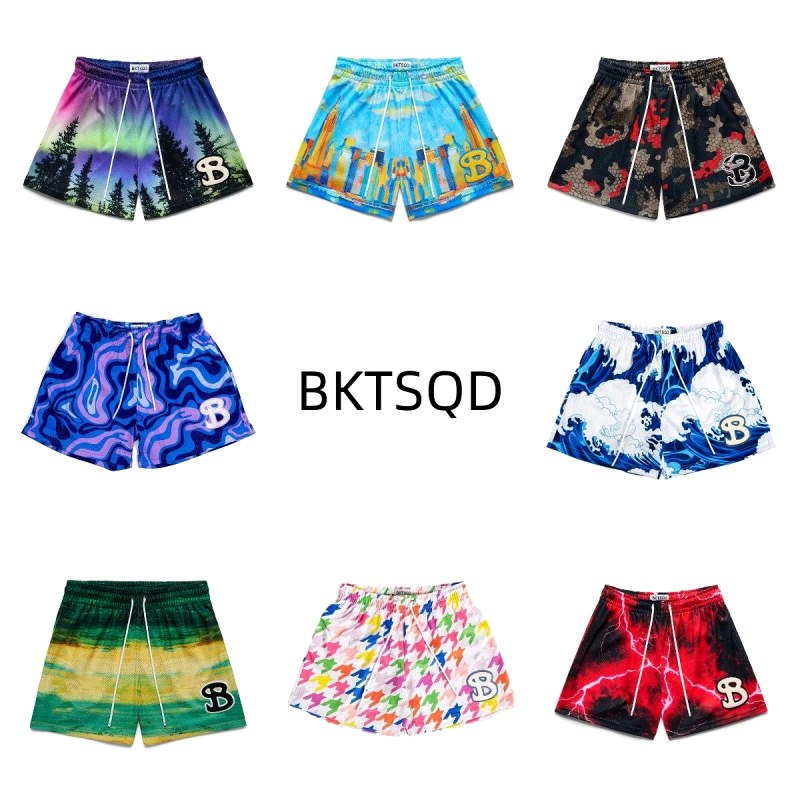
The BKTSQD multicolor shorts collection is a $10.15 unisex short sold in a loose, straight-leg shape with a mid-rise drawstring waist, printed in motifs the listing groups as aurora, geometric, flame, wave and abstract. What made us want to write about it is not the print. It is that two documents attached to the same item describe the same fabric in two different ways: the sourcing sheet behind the listing states a fabric content of 95% polyester and a lining content of 95% polyester, while the retail text simply says "polyester" with a polyester lining. We ordered pairs through Superbuy to find out whether that difference is a paper trail problem or something you can feel.
What arrived and how we tested it
Two pairs arrived at our Hong Kong desk in the standard thin poly mailer, each folded flat inside a clear bag with no hangtag attached and no printed care label visible on the inside waistband seam. The listing's declared weight field reads 0.00 kg; the sourcing sheet's packing block gives a boxed weight figure in grams, so neither number is useful on its own. On our own scale the shorts are light, which is consistent with a thin polyester sport short and with the 0.00 kg placeholder being an unset field rather than a promise.
We compared the pair against three other loose polyester sport shorts we keep for exactly this purpose. We measured the waistband relaxed and stretched, the rise from crotch seam to waistband top, the hem opening, and the inseam; we checked the hem and the drawstring channel under a 10x loupe; and we wore them for running, gym sessions and casual days before washing.
The composition gap: 95% on the sheet, one word on the listing
The 95% figure appears twice on the sourcing sheet — once for the shell and once for the lining — which means the remaining 5% is unspecified on the document we could see. That is normal for wholesale sheets and says little about quality on its own, but it does mean the more precise number is the less consumer-facing one. The retail listing's plain "polyester" is not wrong; it is simply coarser. Treat the figure as a supplier statement we could not verify by fibre test, and treat quick-dry and breathable as catalog claims rather than measured performance.
In the hand, the fabric behaves the way the sheet implies: a smooth, slightly slick woven face with a faint sheen that catches light differently across the print, and a thin, smooth lining layer behind it. It drapes rather than holds shape, which is exactly what you want from a straight-leg short and exactly why the print, not the cloth, carries the look.
Cut, fit and the 1–3 cm tolerance
The listing gives sizes S through XXL, unisex, mid-rise, loose straight-leg, and states a 1–3 cm measurement tolerance. That tolerance figure is the most important number on the page, because it is wider than the gap between some adjacent sizes. Our testers measured consistently with the published chart, but the loose cut means the difference between two neighbouring sizes is forgiving rather than decisive — the drawstring takes up the slack at the waist, and the straight leg does not taper to rescue a short inseam.
| Specification | As listed |
|---|---|
| Price | $10.15 USD (was $12.07) |
| SKU | 7720535002 |
| Sizes | S, M, L, XL, XXL |
| Shell / lining | Polyester / polyester (sourcing sheet: 95% content each) |
| Liner | None listed |
| Cut | Loose, straight leg, mid-rise, drawstring |
| Stated tolerance | 1–3 cm |
| Listed seasons | Spring, summer, autumn, winter |
The four-season listing is marketing range rather than a recommendation. The fabric is thin, the leg is short, and the construction is unlined; our testers reached for these in warm weather and indoors, not in a cold snap.
No liner, and what that means in use
The catalog states no inner liner, so the shorts are a single layer of shell over a polyester lining layer. There is no built-in brief, no mesh support and no compression. For running and gym work that is a neutral choice — lighter, faster to dry, less to chafe — but it is a hard stop if you were expecting a liner, and it makes these a poor substitute for swim shorts regardless of how quickly the fabric sheds water. The drawstring channel is a simple folded-and-stitched tube; under the loupe the stitching was even and the cord ends were heat-sealed rather than knotted, which is the right call on a cord that thin.
Print and finish checks across the variant set
The sourcing sheet lists item codes running from BKTSQD-1 to BKTSQD-80 against a colour field, while the product images show a handful of motif families — aurora, geometric, flame, wave, abstract — with a small B logo low on the leg. That mismatch is the real buying risk here: the code tells you a variant exists, not what it looks like. On the pairs we handled, print edges were clean with no obvious misregistration across the seam, and colour saturation held through our wash cycles without visible bleed into the adjacent light areas. Motif scale, however, varies noticeably between options in the image set, so a large flame graphic in one shot and a small one in another may be the same family photographed at different distances rather than the same print.
Two things we could not settle from the documents: whether these shorts have pockets, and how the print holds up over months of wear. The spec sheet does not name a pocket, and the retail listing does not either, so ask your agent to confirm before ordering if a pocket matters to you.
Value at $10.15
A thin, unlined polyester sport short with a clean print and honest construction at a price where the tolerances, not the tailoring, decide whether you are happy. The sourcing sheet's 95% content figure is the most specific clue you get about the cloth, and the listing's silence on pockets is the most useful warning.
For the money, the shorts do what the listing says: light, quick to dry in practice, comfortable through a run, and easy to fold into a consolidated haul at negligible weight. The case against is equally simple. There is no liner, no buyer feedback to lean on, and a size chart with a tolerance wide enough to make the label size advisory. Order from your own measurements, confirm pockets with your agent, and expect a $10 short rather than a $40 one — because that is what this is.