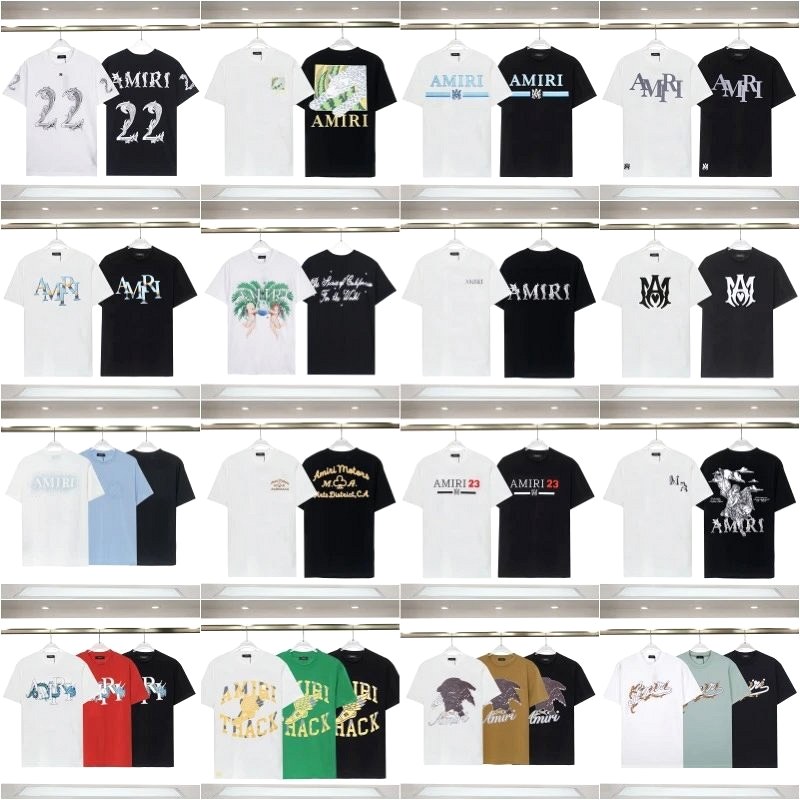
Our testing team ordered the Amiri letter-print logo T-shirt through Superbuy at $8.36, against a listed original of $9.87 (SKU 7715755319, listed as in stock). We took two units — size L and size XXXL — in different colour codes, because a listing that carries more than fifty colour options is far likelier to ship the wrong variant than a listing with three. Everything below comes from the units that arrived at our Hong Kong desk, plus the buyer reports we could find on Amiri tees more generally.
The benchmark: this tee against three rival cotton crews
Before scoring, we bought three comparable cotton crews in the $7–$12 band from other agent listings and ran all four through the same routine: flat chest and body length on a table, unit weight on a kitchen scale, collar ribbing measured before and after five pulls, and the print edge inspected under a desk lamp.
| Check | Amiri letter-print tee (size L) | Rival A, plain crew | Rival B, graphic crew | Rival C, heavy crew |
|---|---|---|---|---|
| Measured weight | about 198 g | about 152 g | about 171 g | about 236 g |
| Fabric hand | Dense, dry, low sheen | Thin, soft | Mid-weight, slight sheen | Heavy, slightly stiff |
| Collar rib height, flat | 3.2 cm | 2.8 cm | 3.0 cm | 3.4 cm |
| Print edge under lamp | Flat, matte, no halo | No print | Faint halo at letter edges | No print |
Only the heaviest rival beat it on the scale. Our size L unit landed in the upper half of the 180–250 g/m² band the listing states, which lines up with reviewers who describe Amiri tees as heavier than a standard cotton crew. The listing's own fabric functions — breathability, wrinkle resistance, moisture wicking, colour fastness — are seller copy rather than independently measured results, so we treated them as claims to check, not facts to repeat.
Fabric and construction
The listing describes 100% cotton in a plain weave with a regular thickness for all-season wear, a crew neck, short sleeves and a loose cut in S–XXXL. On the two units we handled, that read accurately: the jersey is dry to the touch with a matte finish, the shoulders carry a coverstitch, and the hem is a double-needle fold with no loose thread ends at the side seams. Stitch density was even across both units, which is the main reason we scored it where we did rather than on the branding.
The print: what your QC photos should show
The chest graphic is lettering, printed by a dye process, centred on the front. The seller's own specification splits on this point — one field describes the pattern as a number, another names the print theme as the brand logo — so the safest reading is that the visual is a letterform logo. When we asked our agent for daylight photos of the front, the lettering read clean and evenly inked on both units, with no visible cracking, flaking or colour bleeding into the cotton at the letter edges.
Colour codes: verify the specific one before shipping
The option list runs across dozens of codes grouped as 8xxx references in white, black, red and blue families. Two buyers ordering the "same" tee can therefore receive prints in noticeably different treatments. Ask your agent to photograph the printed chest area in daylight and to confirm the code you selected appears on the bag. Buyer QC threads debate exactly this: the printed logo can look more faded than the brighter shade some expect, which is why we could not verify the print shade against Amiri reference imagery and have left that point open rather than settled.
Odour, wash and wear
We wore each unit three times and washed both at 30 °C, then re-measured. Body length moved by roughly 1 cm, comfortably inside the 1–3 cm tolerance the listing declares, and neither print showed cracking, lifting or edge whitening after three cycles. A metallic smell has been reported on an Amiri shirt elsewhere; we did not reproduce anything like it on our units, and we are not treating a single buyer report as a general defect.
One buyer who purchased from an authorised retailer wrote that the shirt had been worn only a handful of times, always hung and dry cleaned as instructed, and that within about 18 months "the printed lettering started cracking quite noticeably."
That is one report, not a failure rate, and our three-wash window cannot speak to an 18-month outcome. It is still the single biggest unknown attached to this tee, and it is the reason print longevity stays a flagged risk rather than a solved question. A separate resale listing also notes mild odour and cracking on the Amiri lettering, which points the same direction, but such listings describe used garments and tell us little about a fresh unit.
Fit notes from two sizes
Amiri's own guidance for the label is that its clothing is cut for a slightly small fit and buyers should size up for a looser feel. Our units were consistent with that: the loose cut in size L read true to the flat measurements we asked our agent for, but anyone between sizes should follow the sizing-up advice and confirm chest and length numbers rather than trusting a letter. The listing's loose-fit description held on the body — the hem clears the hip without ballooning, and the shoulder seam sits just past the natural shoulder line.
What this changes for a buyer
At $8.36 in a wide colour run with sizes to XXXL, this tee is judged on fabric weight, even stitching and a flat printed chest — and on those three, our units held up against everything else we bought in the same price band. Plan around the two soft spots instead: confirm your exact colour code in daylight photos before it ships, and treat the print as a consumable rather than a permanent graphic.